Smart Irrigation for Commercial Properties in North Texas
Most property managers have seen it: sprinklers running in the middle of a rainstorm while tenants walk past. It wastes water, it can put a property out of step with local watering rules, and it tells everyone who sees it that nobody is watching the system.
Smart irrigation is one of the most practical pieces of commercial landscaping technology available today. Here is what it actually does, why it matters in North Texas, and what a property manager should expect from a well-run system.
Why Fixed Schedules Struggle in North Texas
A controller set to “20 minutes, three mornings a week” might have been fine the day it was programmed. North Texas conditions change faster than that.
Clay soil. Much of DFW sits on heavy clay that absorbs water slowly. A long watering cycle can run off into parking lots and gutters before it soaks in. Shorter cycles with a pause between them, often called “cycle and soak,” get more water into the root zone.
Summer heat. Weeks of triple-digit temperatures push plant water demand far above what a spring schedule delivers. A mild week in October needs a fraction of it.
Watering restrictions. Many DFW cities limit landscape watering to two days a week and ban daytime irrigation in summer. When every allowed cycle counts, water spent on the wrong day costs you twice.
Freezes. A system that runs during a hard freeze can ice over sidewalks and drives, and freeze damage to pipes and backflow devices is a common spring repair.
A fixed schedule can’t respond to any of this. It waters by the calendar, not by what the landscape needs.
What an ET-Based Smart Controller Actually Does
“ET” stands for evapotranspiration: the water that leaves the soil through evaporation plus the water plants release through their leaves. On a hot, dry, windy day, ET is high and plants need more water. On a cool, cloudy or rainy day, ET is low and they need less.
An ET-based smart controller uses weather data, from a local weather feed or an on-site sensor, to estimate each day’s ET and adjust run times to match. Instead of following a fixed schedule, it waters to replace what the landscape actually lost.
In practice, that means:
- Watering scales up during a heat wave and back down when temperatures ease
- Rainfall counts, so the controller skips or shortens the next cycle after a good soaking
- Run times are set by zone, so shady beds, sunny turf and slopes each get what they need
- Cycles can be split to suit clay soil and fit inside allowed watering windows
On the properties we manage, we install and manage smart controllers from WeatherTRAK, Baseline, Weathermatic, Hunter Hydrawise and Rain Bird IQ4.
Sensors and Remote Monitoring Catch Problems Early
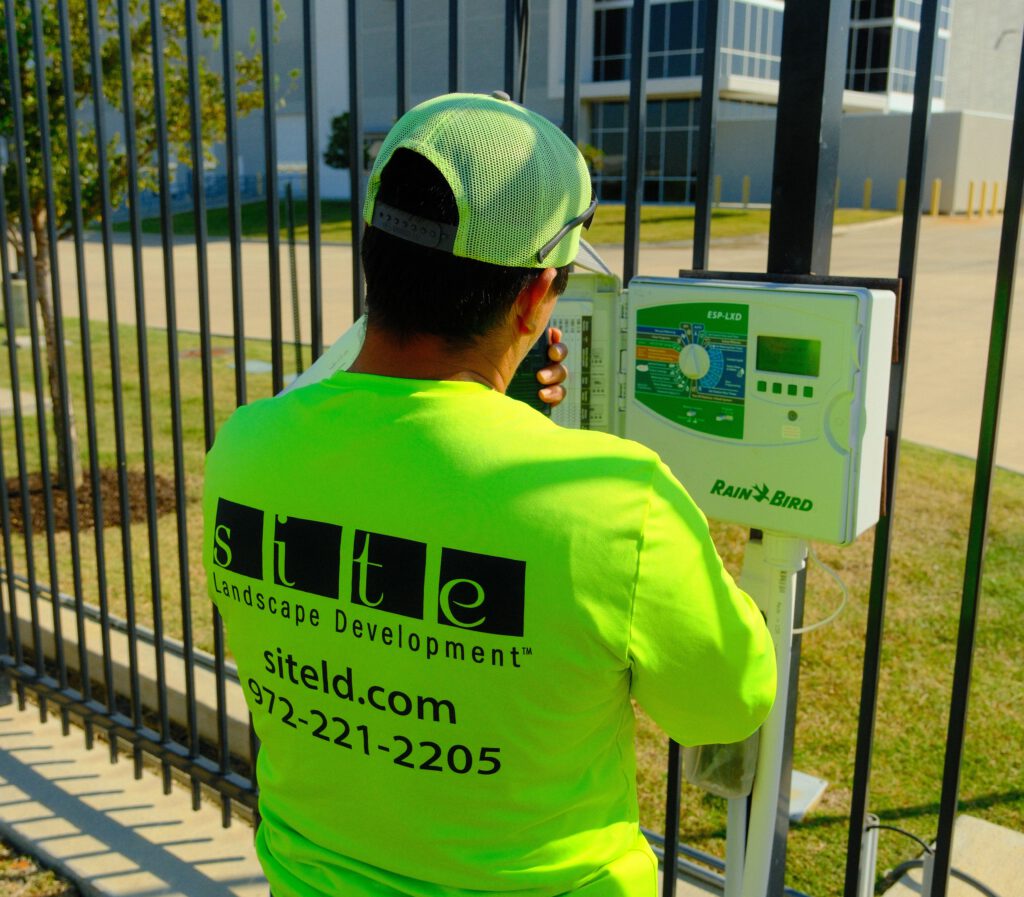
The controller is only half of a smart system. Sensors and remote access are what catch problems before they show up as brown turf or a flooded parking lot.
Rain and freeze sensors pause irrigation during rain or when temperatures drop near freezing.
Flow monitoring compares how much water a zone should use with how much it is actually using. A sudden spike usually means a broken head or a cracked line. A drop can mean a valve that didn’t open.
Remote alerts and access let the irrigation team see a problem and shut down a zone without waiting for the next site visit.
Without monitoring, a broken line can run for days before anyone notices. The first sign is often a soggy bed or a water bill that doesn’t make sense.
We use all of these on the properties we manage. Rain and freeze sensors are standard on our systems: Texas requires a rain shut-off on new automatic irrigation systems, and many DFW cities also require freeze sensors. We pair them with master valves, flow sensors, remote alerts and app access to the controllers.
Some of our properties have run this full setup on the WeatherTRAK platform for more than seven years.
Inspections and Audits Matter as Much as the Hardware
Even the best controller can’t fix a broken sprinkler head or a zone that sprays the sidewalk. Regular inspections and irrigation audits are just as important as the technology.
An irrigation audit typically looks at:
- Coverage: are heads spaced and aimed so water lands evenly, without dry spots?
- Pressure: too high causes misting and drift; too low leaves gaps
- Damage and wear: broken, clogged, sunken or tilted heads, and leaking valves
- Overspray and runoff: water landing on pavement, walls or storm drains
- Programming: whether each zone’s schedule matches its plants, sun exposure and soil
- Backflow: whether the backflow prevention device is in place and tested as required
Fixing what an audit finds is often the cheapest water savings available. A smart controller sending water to a broken head still wastes water.
At SLD, our commercial irrigation services cover inspections and audits, smart controller upgrades, repairs, backflow testing by licensed irrigators, and ongoing water management. We also built our own irrigation inspection application, so findings from the field are documented and shared with account managers.
Staying Compliant With Local Watering Rules
Across much of DFW, the North Texas Municipal Water District sets a permanent minimum watering schedule, and each city chooses its own watering days and can tighten the rules during a drought. Dallas, Fort Worth and other cities served by different water providers set their own schedules, so the rules can vary from one property to the next.
A smart controller makes compliance easier. The allowed days and hours are programmed once, and the controller stays inside them while it adjusts run times to the weather. Someone still has to update the program when a city changes its rules, which should be part of any managed irrigation program.
For the rules themselves, including common violations, see how DFW water restrictions affect your commercial irrigation plan.
What Smart Irrigation Means for Your Property
For property managers, a well-run smart irrigation program can support lower water waste, faster identification of system problems, better seasonal adjustments, more consistent turf and plant health, and improved compliance with local watering requirements.
Questions to Ask Your Irrigation Contractor
You don’t need to become an irrigation expert, but you should know how water is being managed on your property. Ask:
- Is the controller ET-based, and who adjusts it when conditions change?
- How often is the system inspected, and how are findings reported to you?
- Who updates the program when watering restrictions change?
- When was the backflow device last tested?
If the answers are vague, the system is probably running on a fixed schedule.
Getting Started
If your property still runs on a fixed schedule, the first step usually isn’t new hardware. It is an audit to see how the current system performs, followed by a plan to fix the biggest water losses and upgrade the controller where it pays off. Our irrigation team works with property managers across Dallas–Fort Worth on exactly that.